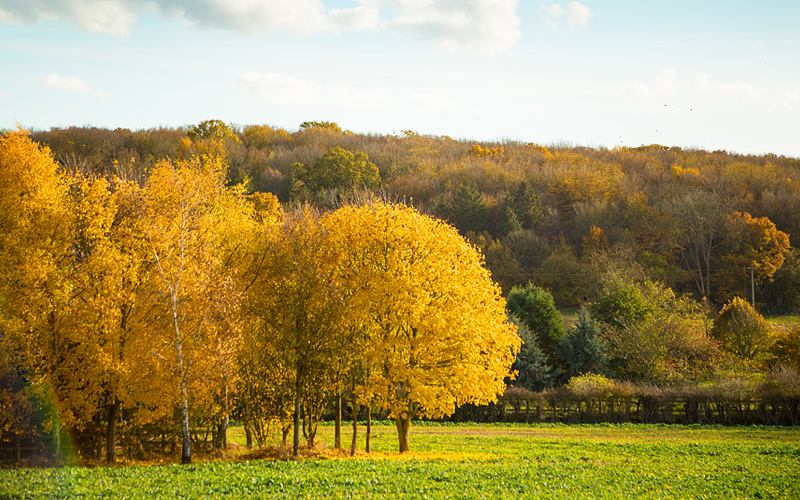
Within 38 separate woodland compartments a wide range of species thrives including Oak, Hornbeam, Sycamore and Western Red Cedars, as well as wildlife friendly scrub. Sadly ash dieback is meaning the loss of almost all ash trees across the estate - a significant loss.
The woods are managed in accordance with Forestry Commission agreed management plans that enable rotational coppicing and felling of small blocks for the purpose of providing wood for the Estate’s bio mass boilers and for its fire log business – C-logs.
In Sawtrees Wood, to the south west of the Estate, there are some 300+ year old oak trees (veteran trees) and potentially some hornbeam pollards of a similar age. In Cooks Wood and Round Wood (also known as Factory Wood) to the north of Sawtrees Wood there are more examples of veteran oak trees.
Two new areas of woodland comprising some 33 hectares were planted in 2012 on sites at Latchford and Cold Christmas. These were awarded Diamond Jubilee Wood status by the Woodland Trust as part of the UK’s celebration of the Queen’s Diamond Jubilee.

The Estate uncovered some interesting history about the woodlands originally called Cook’s Wood, in Barwick. One of our neighbours, Maurice Charge, explained that an explosives factory was built within the woodlands in 1889 by the Smokeless Powder Company and by about 1905 the wood became known as Factory Wood. The name has stuck ever since. Hornbeam timber is used in the production of gunpowder as grown in Factory Wood.
A late 19th Century invention, smokeless powder allowed the development of modern semi- and fully automatic firearms. Burnt black powder leaves a thick, heavy fouling which causes rusting of the barrel. Because the fouling left by smokeless powder exhibits none of these properties it made an auto-loading firearm with many moving parts feasible (which would otherwise jam or seize under heavy black powder fouling).
Why a smokeless powder manufacturer decided to build a factory on the banks of the River Rib at Barwick is not known, but by 1898 the factory had been taken over by the Schultz Gunpowder Co, a German firm. Many of the firm’s German employees were housed on the site until 1914 when, with the start of the First World War, all German nationals were interned and the firm transferred to the Government.
The photograph shows the German factory manager, smartly dressed in what looks like a Homburg hat and shawl-collared coat, along with other employees alongside on of the company’s vehicles. In the late 19th century, a man of African origin must have been an arresting sight in a small village in the Hertfordshire countryside.
The Chaldean Estate is fortunate to have many miles of mature, native hedgerows creating wildlife corridors across the farmed land, bordering our woodland, tracks and the network of country lanes.
The majority of our hedgerows are over a hundred years of age and some are ancient. They comprise oak, ash, field maple, elm, lime, willow and crab apple, along with a diverse range of woody shrubs such as hazel, blackthorn, hawthorn and spindleberry. Old pollards and standard trees of oak, hornbeam and ash can be found as well, and these, along with the hedges generally, support a very wide range of flora and fauna. A few hedges were planted with non-native poplars to create windbreaks but these often have a component of native species too.
After many years of neglect by the previous land owners, the Estate has started an ambitious programme of hedgerow restoration and restocking to diversify their age structure and encourage new growth. Care has been taken to safeguard the veteran hedgerow trees and to select future veterans.