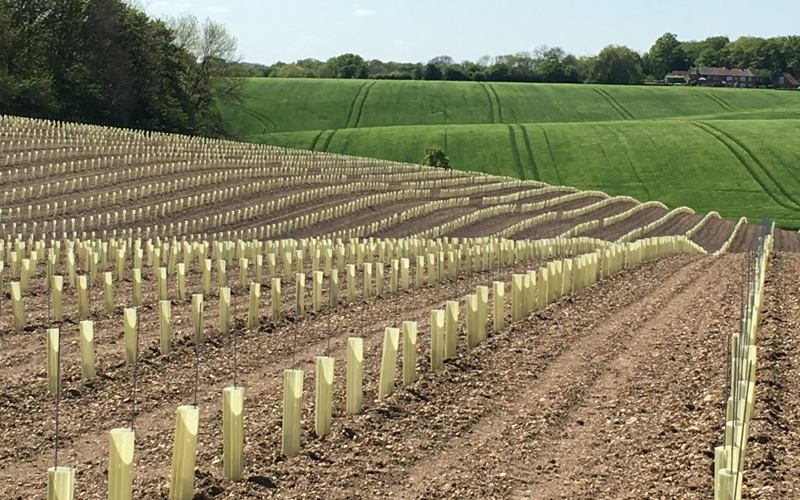
Chaldean Vineyard
In April 2019, Chaldean planted 18,500 vines for grapes on approximately 10 acres of land at Barley Hills, to the north of the Estate. A further 25,000 vines have been planted in 2023 to expand our grape production.
In April 2019, Chaldean planted 18,500 vines for grapes on approximately 10 acres of land at Barley Hills, to the north of the Estate. A further 25,000 vines have been planted in 2023 to expand our grape production.
To diversify our farm production away from general arable production the owners of the estate looked closely at other UK vineyards before reaching a decision to plant vines.
In researching the project, we discovered that, apart from those planted on the wrong sites and with the wrong varieties, many vineyards failed because they found it difficult to produce enough yield to make the enterprise sustainable and/or failed to sell the wines they produced at anything like the price required to cover costs. Importantly, the wines produced need to be of sufficient quality and promoted expertly if one is to succeed.
The rise of UK sparkling wine as a really high-quality product has greatly helped the situation as the price sector that these are currently selling in is much higher and shows a better margin. So this is the sector that the Estate has focused on.
Scale of the enterprise is also an issue as a profitable vineyard needs to benefit from economies of scale.
We are supported by Tom Bunting Vineyard Management, based in the Denham Vale. Our business plan involves growing grapes for juice to be sold to established vineyard wineries located in the more traditional vine growing areas to the south of the country.
Our original vineyard of 10 acres – Hadham Hills is now fully established. Half the vines are Pinot Noir variety and half Chardonnay, the best varieties for English Sparkling Wine. Currently all production is sold on contract to Bolney Wine Estate to be made into their sparkling wine.
In 2023 we planted a further 15 acres known as Great Field. This is an equal split of Baccus, Pinot Noir and Chardonnay. The first year’s growth has been encouraging and should begin producing viable quantities of grapes in 2027. We are now planning a third vineyard taking our total area to 40 acres or 16 hectares to be planted in 2025.
Needing protection from, principally, deer and rabbits, many metres of fencing has been required. We cannot protect the vines from adverse weather – frost being the biggest danger – Establishing a vineyard is a big investment with a period of five years before any real returns. Climate change is moving wine production north, especially away from the Champagne region of France.
As we grow this enterprise, we will need to recruit additional help to undertake all the work involved in managing the vines correctly. This includes pruning, training, crown pruning, leaf thinning and picking at harvest. Please contact the estate office if this is of interest.